Friday, 29 July 2011

Return Visit


This week with the continuing warm and summery weather I decided on a return visit to the Witherslack area of South Cumbria. Last week I had enjoyed my first look at Foulshaw Moss and its special wildlife so I was keen to return to this lovely part of Cumbria. The weather was cloudy until late afternoon and a walk up onto Whitbarrow Scar looking for butterflies proved fruitless. I had lunch down at Foulshaw Moss where a few dragon and damselflies where on the wing. I enjoyed photographing the large fly you can see above nectaring on hemp agrimony. It's identity eluded me until later at home when I think I correctly identified it as one of the horse flies. Apparently it is only the females that bite to feed on blood and the males feed mainly on nectar. We have all experienced the bite of a cleg which can swell up and be painful for a few days. I can only say I wouldn't fancy a bite from one as large as the one shown above !!
Around mid afternoon the cloud began to break up and I decided on a return visit to the Whitbarrow area to look for butterflies. I went to the opposite end of Whitbarrow Scar and visited Cumbria Wildlife Trust's Reserve at Howe Ridding Wood. Coppice management here benefits a number of butterfly species,including pearl bordered,high brown and silver washed fritillary by allowing sunlight to the woodland floor and encouraging plants to flower. Although the sun was out there were not many butterflies on the wing and I only managed sightings of common blues and a few dark green fritillaries one of which is shown above.
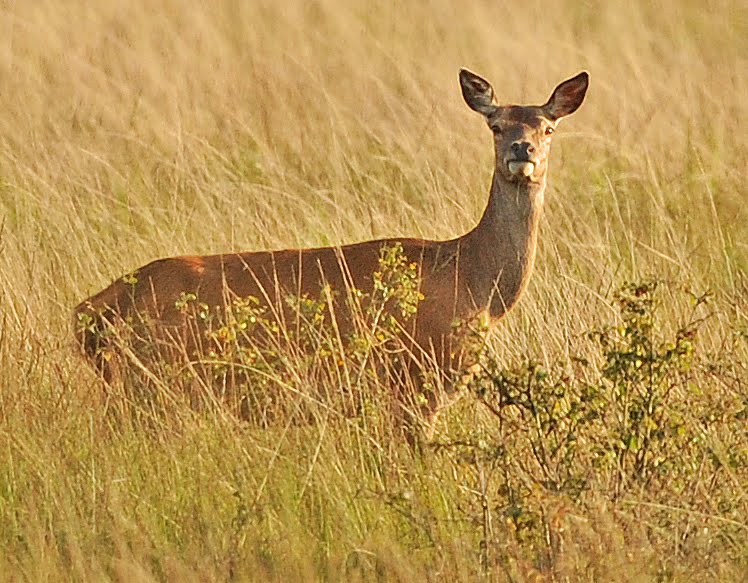
It was now late afternoon and I returned to Foulshaw Moss for an evening's deer watching. The red deer eventually came out of hiding way out on the moss and one of the hinds came much closer to the viewing platform where myself and fellow photographer Richard Witham were waiting for photographic opportunities. We exchanged traveller's tales,Richard having travelled all over the world in pursuit of his passion for wildlife and landscape photography. If my readers are interested they can view Richard's website at www.richardwitham.com We were pestered by a swarm of flying ants which attracted the attention of a group of swallows fattening up for their long journey south. The finale came as an osprey flew in to land in the group of pines still standing out in the centre of the moss. Ospreys are daily visitors to this area and will I am sure soon be taking up residence at this ideal location for their continued expansion from further north. It was a fitting end to another super day out in this beautiful part of Northern England.
As usual a few images from the day are shown above with the red deer, osprey,emerald damselfly and horsefly from Foulshaw Moss and dark green fritillary from Whitbarrow. I have also included images showing the views out onto Foulshaw Moss and the woodlands at Whitbarrow Scar. Hope my readers enjoy my account and images and many thanks for looking .

Friday, 15 July 2011

Witherslack Mosses


For this week's trip I had decided to cross the border and explore the area around Witherslack in South Cumbria. This is a fabulous area for the naturalist and has some wonderful nature reserves managed by the Cumbria Wildlife Trust. I knew the area reasonably well having done some butterfly and plant hunting a few years ago. The very warm weather continued and it seemed an ideal opportunity to spend the day around the village of Witherslack which gives access to the nearby Foulshaw and Meathop Mosses and to the extensive woodlands underneath the magnificent limestone escarpment of Whitbarrow Scar.
I began the day looking for dragonflies at Foulshaw Moss and was kept busy photographing the delightful black darters which posed obligingly on the bankside vegetation bordering one of the delightful pools at Foulshaw. From here I went into the extensive woodlands at Witherslack to look for the large fritillary butterflies to be found there. I came across one or two clearings in the woods which had many brambles in flower and from time to time the fritilaries were visiting to nectar on the flowers. They were not easy to photograph but I did manage some shots of a mating pair which are shown above. Other butterflies present were common blues and dark green fritillaries.
For the remaining time I returned late afternoon to Foulshaw Moss. There was less activity from the dragon and damsel flies but red deer were beginning to come out of hiding way out on the moss. I had nice but distant views of the deer but was suddenly aware of a fox quite close to the viewing platform and making it's way out onto the moss through the rough grasses and sedge vegetation. I managed a couple of shots before the fox heard the camera shutter and rapidly vanished. Not long after that super views were had of a visiting Marsh Harrier which came fairly close and gave great views in the evening sunshine.
It was now time to make the journey home after what had been a wonderful day with the camera in this very special area of Cumbria. I was very pleased with the results and have shown above some of the day's highlights. I can't wait to return for more wildlife encounters in this part of Cumbria. I hope my readers enjoy the images posted above of black darter dragonfly , emerald damselfly ,and mating pair of silver washed fritillaries. The highlight of a wonderful day was of course the fox and the fly past of the marsh harrier both shown above and one or two of the magnificent scenery in this part of the world.

Thursday, 7 July 2011

Close Encounters


Just a few more from last week's visit to see a pair of local barn owls. They are a very special bird to see and photograph and Martin and I were very lucky to be in the right place at the right time.The images are very similar to my last posting but it is not often that all comes right on the day and you are lucky enough to obtain lots of images. Many of these were discarded but enough remained which I considered good enough to warrant a further posting.
So I hope my readers enjoy yet more barn owl images and I may return soon to try and improve on those shown above. For the technical amongst you the images were obtained using a 500mm .f4 lens coupled to a 1.4 X convertor giving me quite a reach and I was thus able to obtain some detailed close up shots of the owls.

Sunday, 3 July 2011

Early Birds


On another beautiful summer's day in the current spell of settled weather I had decided on an early start to hopefully see and photograph a pair of barn owls which had been providing excellent views early morning and late evening at a location not very far from home. I was at the site before six a.m. and was soon joined by my good friend Martin, a very keen local bird photographer and naturalist. We concealed ourselves at a convenient spot overlooking an area favoured by the owls for hunting.
For around an hour or so there was no sign of the barn owls and we thought they may have retired early following a good night's hunting. This thankfully wasn't the case and around six fifty a.m. they appeared. For the next quarter of an hour they patrolled around the area where we waited and we were treated to some fabulous close views of these enigmatic and very beautiful birds. We were kept very busy with the cameras and managed to obtain an excellent series of images.
Martin had to leave early and I stayed on for about another hour but the owls chose to hunt in areas out of camera range but it was still a delight to observe them on a beautiful summer's morning. Around eight thirty a.m. I decided to leave them in peace and head home for breakfast and to reflect on what had been a superb early morning with these wonderful birds. Some images are shown above, a selection of many I took, and I am sure I will post a few more in the days to come. Hope my readers enjoy looking at them as much as I did in capturing them. I must make the effort again soon and join the owls on their early morning hunting forays.

Wednesday, 29 June 2011

More Gannets


Just posting a few more gannet shots from Bempton. These ones are showing the birds at their nest sites on the cliffs rather than flight shots. I couldn't get close to the sitting birds and for the most part they were in the shadow of the cliffs so images are not brilliant !! Also posting one or two more of the general scenery of this dramatic part of the Yorkshire coastline. More images will follow later of the other inhabitants of Bempton Cliffs.

Bempton Cliffs


On Sunday Kath and I made the long journey to the east coast to visit the RSPB reserve at Bempton Cliffs near Flamborough Head. After a three hour journey we were pleased to find a parking place and have lunch before venturing down to the cliffs. Bempton is part of England's largest seabird colony with eight species nesting on the 400 ft high cliff faces. Bempton is famous as the only English gannet colony and the only one on the British mainland. The gannet is the most obvious bird you will see at Bempton and you cannot fail to be impressed as these large birds cruise along the clifftops and crowd onto their nesting ledges and provide spectacular viewing.
It is a dream destination for a bird photographer and provides endless opportunities to capture the constant action on and around the cliffs. So it was that I set out on my mission to bring back some memorable images on what was to be the hottest day so far this year. I joined the many visitors at the cliff top viewing areas and for the next four hours or so filled up the memory cards with hundreds of images.
In this first posting I have concentrated on the star bird, the gannet, but a further posting will feature the other residents such as kittiwakes, fulmars , guillemots , razorbills, etc..etc. It was not easy to capture the gannets on camera as they flew by ..sometimes at eye level.. and you had to be ready , focus , and fire the shutter and hopefully the results would be in focus and pleasing to the eye. Of course this is never the case and a lot of the shots have to be discarded but I did have a few decent images to show for my day's work. I have shown a selection above together with a couple showing the impressive scenery at Bempton and hopefully my readers will enjoy them as much as I did in trying to capture the action from this spectacular coastline. I will post more from the day out at a later date and show more of the residents of Bempton Cliffs.

Thursday, 23 June 2011

Tern Return


This week has once again produced very mixed and unsettled weather. It has at times been more like April than June with frequent heavy showers. There have however been brighter interludes and Tuesday was one such day. The afternoon promised some sun so I thought I would return to Preston Docks to catch up on the progress of the tern colony which is thriving at this location. On arrival there was yet another beefy shower but then the promised sunshine and blue skies eventually arrived.
Fellow photographers Martin and Geoff were already there and were enjoying the sights and sounds of the tern colony and were busy capturing the action. I set up the big lens and tripod and was soon into action trying to capture these elegant fast flying birds as they were kept busy attending to their families. Since my last visit a month ago quite a number of the terns have successfully reared their chicks some of which had left the security of their tyre homes. Other tern families have nested on the gravel and shingle which has been put down on the pontoons. All in all they are having a very good season and a good number of chicks and fledglings are doing well.
A very enjoyable couple of hours was spent capturing the action in and around the various nests and the images above show the comings and goings of the various tern families as they attented to their hungry chicks. One pair of common terns are still incubating their eggs and can be seen above exchanging nest duties and the three eggs can be seen beneath the parent. Most of the fish being provided for the young terns are presumably being caught from the nearby River River Ribble and appear to be small roach. Hope my readers enjoy looking at life in and around this tern colony and I will return soon to follow the progress and capture more of the action.